Monday, 15 July 2013

Monday, 3 June 2013
Cock & Bull Stories - 8 Organisational Metaphors,
Cock & Bull Stories - 8 Organisational Metaphors,
A cock and bull story- Meaning, A fanciful and unbelievable tale! origin

By now, you may have noticed the 'widely reported' and 'supposed' adjectives above and picked up that I don't believe a word of it. It is an appealing story but, regrettably, it is little more than that. There's no evidence whatsoever to connect the two inns with the phrase, apart from the coincidence of the two names.
 Whisper it not in Stony Stratford if you want to get out alive, but it's more likely that the phrase comes from old folk tales that featured magical animals. The early 17th century French term 'coq-a-l'âne' was glossed in Randle Cotgrave's A Dictionarie of the French and English Tongues, 1611 as meaning:
An incoherent story, passing from one subject to another.
The literal translation of 'du coq à l'âne' is 'from rooster to jackass', which nicely fits the meaning of the term. This was later taken up in Scots as "cockalayne", again with the same meaning. The first citation of 'cock and bull' stories in English is from Robert Burton's The Anatomy of Melancholy, 1621:
"Some mens whole delight is to talk of a Cock and Bull over a pot."
The Eight Metaphors of Organization
by VENKAT on JULY 13, 2010
By Stan Felstead - Interchange Resources
The strong point of this book is that it strengthens your personal radar -the ability to 'read' organizations. Probing what is really going on and the underlying influences. A classic book in its field.
The strong point of this book is that it strengthens your personal radar -the ability to 'read' organizations. Probing what is really going on and the underlying influences. A classic book in its field.
Gareth Morgan’s Images of Organization is a must-read for those who want to develop a deeper understanding of a lot of the stuff I talk about here. Though I’ve cited the book lots of times, it is one of those dense, complex books that I am never going to attempt to review or summarize. You’ll just have to read it. But I figured since I refer to it so much, I need at least a simple anchor post about it. So I thought I’d summarize the main idea with a picture, and point out some quick connections to things I have written/plan to write.
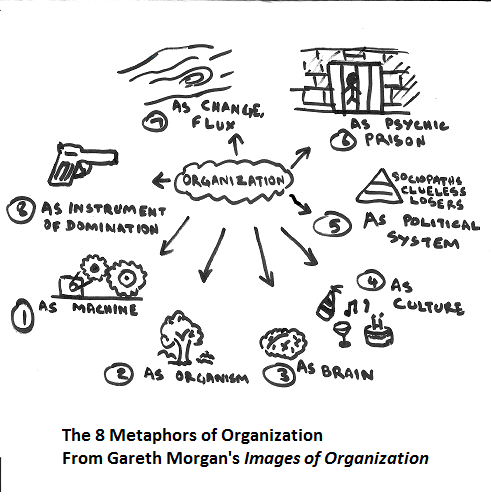
(For once, the picture was complex enough that I chose to draw it and scan it in, instead of doing one of my ugly MS-Paint sketches). Here’s the main idea of the book –The Eight Metaphors
Morgan’s book is based on the premise that almost all our thinking about organizations is based on one or more of eight basic metaphors. The main reason this book is hugely valuable is that 99% of organizational conversations stay exclusively within one metaphor. Worse, most people are permanently stuck in their favorite metaphor and simply cannot understand things said within other metaphors. So these are not really 8 perspectives, but 8 languages. Speaking 8 languages is a lot harder than learning to appreciate 8 perspectives. I consider myself a bit of an organizational linguist: I speak languages 2, 5, 6 and 7 fluently, 1 and 3 passably well (enough to get by), and 8 poorly.
- Organization as Machine: This is the most simplistic metaphor, and is the foundation of Taylorism. Any geometrically structuralist approach also falls into this category, which is why I have little patience for people who use words/phrases like top down, bottom-up, centralized, decentralized and so forth, without realizing how narrow their view of organizations is. The entire mainstream Michael-Porter view of business is within this metaphor.
- Organization as Organism: This is a slightly richer metaphor and suggests such ideas as “organizational DNA,” birth, maturity and death, and so forth. I really like this one a LOT, and have so much to say about it that I haven’t said anything yet. I even bought a domain name (electricleviathan.com) to develop my ideas on this topic separately. Maybe one day I’ll do at least a summary here.
- Organization as Brain: This may sound like a subset of the Organism metaphor (and there is some overlap), but there is a subtle and important shift in emphasis from “life processes” to learning. Organization as brain is the source of information-theoretic ways of understanding collectives (“who knows what,” how information spreads and informs systems and processes). The System Dynamics people like this a lot, especially Peter Senge (The Fifth Discipline). I cannot recommend the SysDyn approach though; I think it is fundamentally flawed. But the learning view itself is very valuable.
- Organization as Culture: I’ve written about this stuff before (There is No Such Thing as Culture Change on the E2.0 blog), and plan to do so soon, when I review Tony Hsieh’sDelivering Happiness and in the next Gervais Principle post. I honestly dislike this metaphor, but can understand its appeal objectively. More so than others, culturalists tend to be extremists; they think the culture metaphor is the most important one, and this rigidity traps them in peculiar ways.
- Organization as Political System: Most of the Gervais Principle series falls within the boundaries of this metaphor, though I sometimes step out to the Psychic Prison metaphor.
- Organization as Psychic Prison: I chose to represent this as a guy in a prison, since that is immediately obvious to everybody, but the right symbol (and the one Morgan uses) is the Plato’s cave symbol, which would be obscure to most people even if I could sketch it in a recognizable form. We’ve talked about this on the edges of the Gervais Principle series, through our discussions of exile/exodus, and also extensively in my oldCloudworker series.
- Organization as System of Change and Flux: Think of a dynamically stable whirlpool or eddy in a flowing stream, and you get this one. It highlights some of the same aspects of organizations as the Organism metaphor, but in different ways. For example, notions of stability, dissipation, entropy, and other physics ideas are used. This is where things like GTD, lean startups and agile programming fit. The idea of creative destruction also fits in here. If the Machine metaphor is the dominant one, this one is the market-leading alternative metaphor.
- Organization as Instrument of Domination: This is NOT the same as the political metaphor, since it involves naked aggression in some form. This is where you get themes of oppression, sweat-shops, social costs (such as the BP oil spill), the military-industrial complex and so forth. This used to be a lot more important than it is now, because humans are selfish creatures. So long as the subjects of oppression were human laborers, this was the leading metaphor. The moment that variety of oppression began to wane, and corporations shifted their oppressive gaze to animals, via factory farming, and the environment, via wanton damage out of public view, we stopped caring as much. Fortunately, that is starting to change, because ‘out of public view’ is an increasingly difficult state to maintain. Cases in point: Iran, Burma and BP.
There is a lot to be said about each metaphor. Morgan’s book is not particularly original in its analysis, but it is magisterial in its scope, coverage and organization. It surveys and contextualizes a lot of work by others in organizational theory. Bits of it can be tedious and too cautious/conservative, but overall, this is one of those “get your foundational education” books that you truly must read. I don’t want to tempt you into an illusion of understanding with this post, but just give you a taste of what is in store for you, if you choose to read the book.
I plan to do a series of such quick-tastes of books that I consider very important, but don’t plan to review/summarize.
Sunday, 2 June 2013
What makes us feel good about our work?

 What makes us feel good about our work?
Contrary to conventional wisdom, it isn't just money. But it's not exactly joy either. It seems that most of us thrive by making constant progress and feeling a sense of purpose. Behavioral economist Dan Ariely presents two eye-opening experiments that reveal our unexpected and nuanced attitudes toward meaning in our work. (Filmed at TEDxRiodelaPlata.)


- "If you want to know why you always buy a bigger television than you intended, or why you think it's perfectly fine to spend a few dollars on a cup of coffee at Starbucks, or why people feel better after taking a 50-cent aspirin but continue to complain of a throbbing skull when they're told the pill they took just cost one penny, Ariely has the answer." Daniel Gross, Newsweek
In Business Training
In Business Training
Advantages of in-business training include:
- Cost savings with more effective group training.
- Training times crafted around your schedule.
- The ability to address specific employee training needs
- Reduced travel time with on-site training
- Convenience - Programs are delivered at a time, location and pace that fit in with your business schedule.
- Hand picked trainer/s that fits to your training needs
Customised Training Programs (CTPs)
We can bring our Training workshops directly to your workplace or we will customise training to meet your specific needs ensuring effectiveness in achieving real performance improvement.
 A customised training in your work environment!
If your needs are either to train supervisors, employees, a whole team or a trainer, Taylor Mason is available to help you plan your training strategies and conduct the In Business Training as per your requirements.
Prior to conducting the In Business Training, Taylor Mason will analyse the needs of your company. In addition to considering the materials your employees handle, we will determine if there are many particular topics or problems you would like to have addressed during the In Business Training. These tailored courses are designed exclusively for your company, with specific reference materials provided to the attendee to relate to as a reference and information resource.
The productive interaction of participants who have the opportunity to learn together and discuss what they have been taught continues long after a course has ended. This is the real key to effective training, the successful acquisition and use of knowledge.
Taylor Masons experienced trainers are top in their field. They can develop and deliver many types of programs with your particular requirements, together with practical suggestions for effective implementation.
Taylor Mason programme trainers are recognised experts in their field with many years of experience in interpreting and teaching the needs of the industry and the government professionals in all areas of Regulatory and Compliance, IT & Software, Customer Service, Health & Safety, Management & Leadership, HR, and Manufacturing. Our professional trainers are available to provide your organisation with the highest quality In Business Training programmes.
Wednesday, 8 May 2013
Business Training - Accredited Supervisor Training Level 3 - Edinburgh 3rd June @ UK
 Your first step to a successful career in management
This 1 day accredited level 3 Supervisor & Team Leader training course provides new or existing supervisors with the underpinning skills and knowledge to become exceptional team managers.
The course has been designed to ensure that all supervisors whether recently promoted or already in post, gain all the skills they need to become an effective supervisor whilst being officially recognised for their new skills.
 This course is licensed, accredited and regulated by the Open College Network who are members of the CIPD and ILM. The Open College Network is a leading UK awarding organisation, offering high quality, flexible, credit-based qualifications supporting both the National Qualifications Framework (NQF) and the new Qualifications and Credit Framework (QCF).
Upon completion you will receive an accredited certificate at Level 3 from the Open College Network.
Upon completion of this supervisor course delegates should be able to:
- Identify best practice in giving verbal feedback
- Use the EEEC model (Example, Effect, Expectation, Consequence)
- Understand and be able to give feedback positively
- Be able to give consistency, personally and as part of a group
- Set and maintain standards
- Be able to prioritise effectively and understand how to make good decisions and use prioritising techniques
- Delegate successfully
- Be able to motivate teams
- Understand strengths and weaknesses within the team (SWOT)
- Be an effective time manager
- Create and link back to the workplace an action plan to help embed the training to their everyday duties
- Understand your own and others expectations and responsibilities of the supervisory role
- Prioritise workloads – be more time efficient
- Develop skills of delegation and put them in to practice
- Develop effective feedback techniques, both with your team and senior management
- Understand your team, its dynamics and utilise motivational techniques to get the best from them.
Public course locations and dates- Price - £275 per delegateTestimonials
Run In House In Business Courses - £875 per day - Duration: This course is delivered over: 1 day
- "I learnt a lot from this course, very useful" Elaine McCarthy - Fiddes Payne
- "I enjoyed the course and have picked up new skills" Gemma Black - Cambridge Manufacturing
- "Fantastic course, Natalie was great" Anthony Lowe - Private Delegate
Customised Training Programs (CTPs)
We can bring our Training workshops directly to your workplace or we will customise training to meet your specific needs ensuring effectiveness in achieving real performance improvement.
*All prices are excluding VAT, travel is charged with In-house courses at 45p per mile.
*Book 2 delegates and receive a 10% ex Vat discount - On the booking page click on 'Apply promo or voucher' type in 2delegates and continue your booking
Please choose the suitable date search, pick the highlighted date you require on the calendar below, confirm the course chosen is correct and click on book now below.
-1-1-120313.jpg)
Subscribe to:
Comments (Atom)